

Cart
0
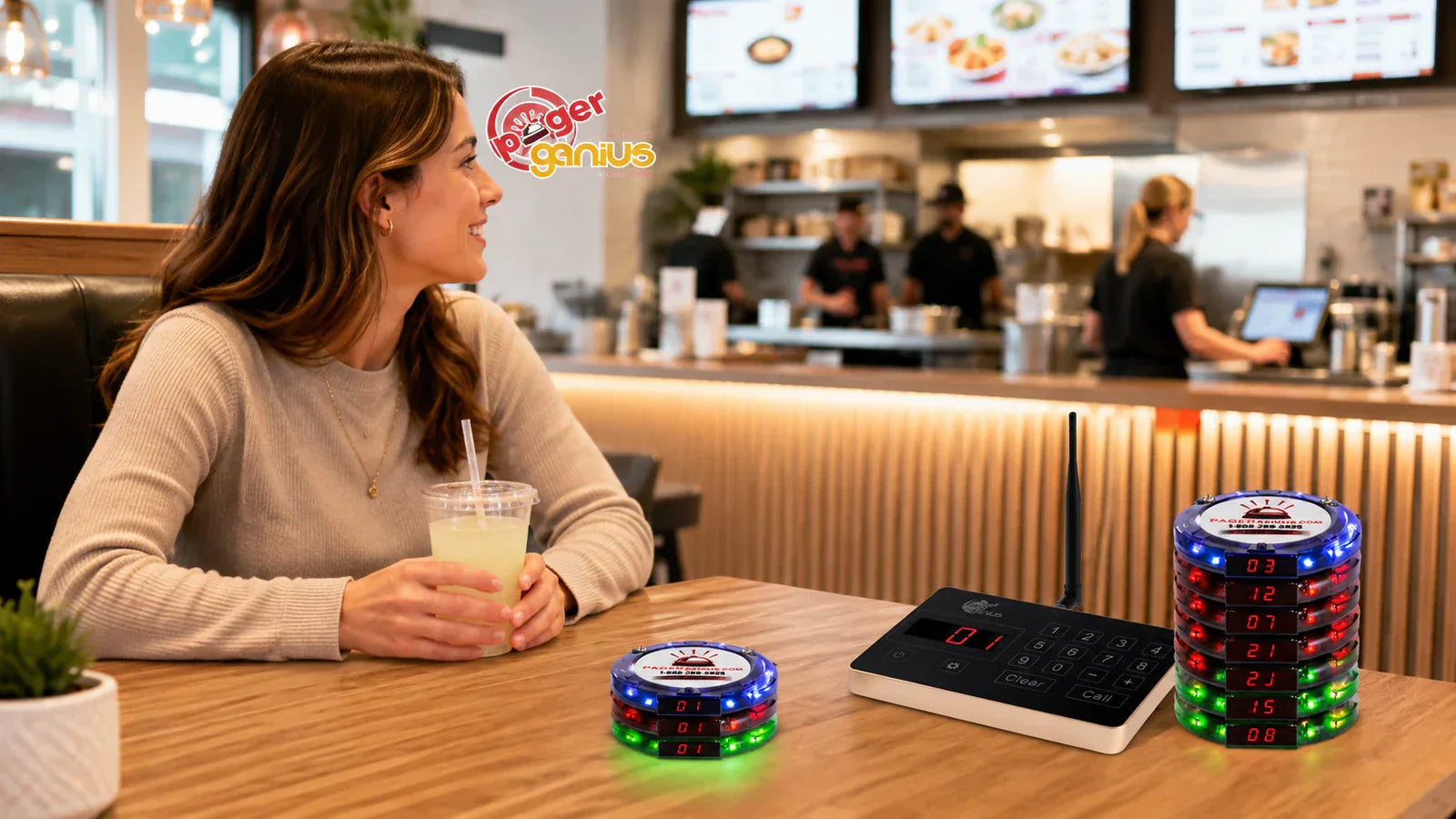
Restaurant Pagers: The Complete Guide to Food Pickup, Waitlists, and Counter Crowding
Flagship restaurant paging guide
Built for restaurant operators who want a calmer pickup counter, faster guest notification, and fewer interruptions during rushes.
72-hourstandard battery life
60-minutefull charge
Up to 1-milerange, environment dependent
125-hourspecial-order battery option
The best pickup counter is empty until the order is ready.
That might sound simple, but it is one of the biggest differences between a restaurant that feels calm and a restaurant that feels chaotic.
In a fast casual restaurant, guests order first, pay, and then wait for their food. Without a clear notification system, they hover near the counter. They watch the kitchen. They listen for their name. They ask staff if their order is ready. Sometimes they miss the call. Sometimes they grab the wrong bag or tray. Sometimes the pickup area gets so crowded that new customers can barely place an order.
Restaurant pagers solve that problem.
A guest orders, receives a pager, sits down or waits nearby, and returns only when the pager alerts them that the food is ready.
No yelling names. No crowded pickup counter. No app download. No phone number required. No monthly texting platform required.
For full-service restaurants, pagers also help manage waitlists and notify guests when tables are ready. But for fast casual restaurants, breweries, food trucks, cafeterias, food halls, resort pools, cafes, BBQ restaurants, burger shops, pizza restaurants, and other counter-service concepts, restaurant pagers do something even more important.
They create a smoother order-to-pickup flow.
That is why restaurant pagers still matter.

Quick Answer: What Are Restaurant Pagers?
Restaurant pagers are wireless guest notification devices that alert customers when their food, drink, service, or table is ready.
A typical restaurant paging system includes a transmitter, rechargeable pagers, and a charging base. Staff hand a pager to the guest, then enter that pager number on the transmitter when the order or table is ready. The pager alerts the guest with vibration, lights, sound, or a combination of alerts.
Restaurants use pagers for:
- Fast casual food pickup
- Counter-service restaurants
- Full-service waitlists
- Breweries and taprooms
- Food trucks
- Cafeterias
- Food courts and food halls
- Resort pools and patios
- Coffee shops
- Pizza, BBQ, burger, deli, and sandwich shops
- Staff and server communication
The goal is simple: notify the right person at the right time without shouting, searching, texting, or creating a crowd.
The Real Problem Restaurant Pagers Solve
Most articles about restaurant pagers focus on waiting for a table.
That is only part of the story.
For many restaurants, the bigger issue is not the host stand. It is the pickup counter.
In fast casual and counter-service restaurants, customers have already paid. They are not deciding whether to wait for a table. They are waiting for food that is being made for them.
That creates a different operational problem.
When the order is not ready yet, where should the customer go?
If the answer is "stand near the counter and listen," the restaurant eventually gets crowded. Staff have to yell names or numbers. Guests keep checking on orders. The pickup shelf fills up. The dining room feels more chaotic than it should.
A restaurant pager gives the customer permission to stop watching the counter.
The guest can sit down. They can wait outside. They can return to their group. They can relax instead of hovering.
When the order is ready, the pager brings them back.
That is the entire value.
Restaurant pagers are not just notification devices. They are crowd-control tools, guest-experience tools, and workflow tools.
Operator takeaway
The pager is not the strategy by itself. The strategy is the workflow: order, assign pager, let the guest sit down, page only when the order is ready, then reset the pager for the next guest.
The Counter-Clear Method
At Pager Genius, we recommend thinking about restaurant pagers through a simple operating principle:
Keep guests away from the pickup counter until their order is actually ready.
Call it the Counter-Clear Method.

Here is how it works.
1. Order
The customer orders and pays at the counter, kiosk, bar, food truck window, or register.
2. Assign a Pager
Staff hand the guest a numbered pager and connect that pager number to the order.
This can be done on the receipt, kitchen ticket, POS note, expo station, or order rail depending on your workflow.
3. Let the Guest Sit Down
The customer sits in the dining room, waits on the patio, returns to their group, or moves away from the counter.
They no longer need to listen for their name or stare at a screen.
4. Finish the Order
The kitchen, bar, or expo team completes the order.
This part matters: do not page the customer before the order is actually ready.
5. Page the Guest
Staff enter the pager number and press call.
The pager alerts the customer.
6. Pickup
The guest returns to the counter, receives the order, and gives back the pager.
7. Reset
The pager is returned, cleaned if needed, placed back on the charging base, and made ready for the next customer.
That is the system.
It is simple enough for new employees to learn quickly and clear enough for customers to understand immediately.
How Do Restaurant Pagers Work?
Restaurant pagers work by sending a wireless signal from a transmitter to an individual pager.
In most restaurant workflows, the process looks like this:
- The staff member gives a guest a pager with a number on it.
- When the food, drink, table, or service is ready, the staff member enters that number into the transmitter.
- The transmitter sends a signal to that pager.
- The pager vibrates, flashes, beeps, or uses whatever alert mode the restaurant chooses.
- The guest returns to the pickup counter, host stand, bar, or service area.
- The pager is returned and reused.

The best restaurant pager systems are intentionally simple. They do not need to replace your POS. They do not need to change your kitchen workflow. They do not need customers to download an app or share their phone number.
They just notify the guest when it is time to come back.
Why Fast Casual Restaurants Use Pagers
Fast casual restaurants are one of the strongest use cases for restaurant pagers.
In a full-service restaurant, guests are usually waiting for a table.
In a fast casual restaurant, guests are usually waiting for food.
That difference matters because the guest has already paid. They are in the restaurant. They are expecting a smooth handoff.
Restaurant pagers help fast casual restaurants:
- Reduce pickup counter crowding
- Stop yelling names and order numbers
- Keep guests seated while food is prepared
- Reduce "Is my order ready?" interruptions
- Prevent guests from missing their order
- Make the dining room feel calmer
- Keep the line clear for new customers
- Improve the handoff between kitchen and guest
This is especially useful for restaurants with made-to-order food, where prep times can vary by order.
A burger may take five minutes. A large pizza may take fifteen. A BBQ platter may come out quickly unless sides are backed up. A coffee order may be ready fast, but food may take longer.
A pager gives each guest a direct signal when their specific order is ready.
That is better than making every guest watch the counter.
Which Restaurants Benefit Most From Pagers?
Restaurant pagers are useful anywhere guests wait on-site or nearby.
They work especially well for:
- Fast casual restaurants
- Burger restaurants
- BBQ restaurants
- Pizza restaurants
- Sandwich shops
- Delis
- Coffee shops
- Bakeries
- Breweries
- Taprooms
- Food trucks
- Food halls
- Food courts
- Cafeterias
- Hospital dining
- Campus dining
- Resort pools
- Hotel cafes
- Golf course grills
- Counter-service seafood restaurants
- Full-service restaurants with waitlists
The best fit is any restaurant where staff need to say:
- Your food is ready.
- Your table is ready.
- Your drink is ready.
- Please come back to the counter.
- Your party can be seated now.
A pager makes that message instant and obvious.

Restaurant Pagers for Full-Service Restaurants
Restaurant pagers are still useful in traditional full-service restaurants.
In that setting, they are usually used for waitlists.
A host gives a pager to a waiting party. The guests can wait outside, at the bar, on the patio, in the lobby, or nearby. When the table is ready, the host pages the party.
This helps the restaurant avoid a crowded host stand.
It also gives guests more freedom while they wait.
Full-service restaurants often use pagers for:
- Weekend dinner rushes
- Brunch waitlists
- Patio seating
- Large parties
- Shopping-center restaurants
- Family restaurants
- Steakhouses
- Seafood restaurants
- Tourist-heavy locations
- Restaurants with outdoor waiting areas
A pager helps the guest feel connected to the restaurant without standing directly in front of the host stand.
That is valuable.

But restaurant pagers should not be discussed only as waitlist tools. For many modern restaurants, the food pickup workflow is just as important.
Restaurant Pagers vs. Text Messaging
A lot of restaurants ask the same question:
Should we use restaurant pagers or text messages?
The honest answer is that both can work.
The better question is: where is the guest waiting, and what do you need them to do?
If the guest is waiting on-site for food they already paid for, a physical pager is often the simpler option.
If the guest may leave the property, join a remote waitlist, or need two-way communication, text messaging may be better.
| Feature | Restaurant Pagers | Text Messaging |
|---|---|---|
| Guest needs a phone | No | Yes |
| Guest shares phone number | No | Yes |
| App download required | No | Usually no |
| Wi-Fi or cell service required | No for traditional paging systems | Yes |
| Monthly software fee | No for many hardware systems | Usually yes |
| Two-way communication | No | Usually yes |
| Good for food pickup | Excellent | Good |
| Good for remote waitlists | Limited | Excellent |
| Works for guests without smartphones | Yes | No |
| Hardware to manage | Yes | No |
| Customer privacy concern | Lower | Higher |

Text messaging is not bad.
It is just not always necessary.
For a long waitlist where guests leave the restaurant, texting can be useful.
For a fast casual pickup counter where the customer is already nearby, pagers are often cleaner. Staff do not need to collect phone numbers. Guests do not need to watch their phone. The system does not depend on cell service. The restaurant does not need another monthly subscription just to say "your food is ready."
That is the difference.
Are Restaurant Pagers Outdated?
Restaurant pagers are outdated only if you think every restaurant problem needs to be solved with software.
Many restaurant problems do not.
Sometimes the best tool is the one that does the job with the fewest steps.
A pager does one thing well: it tells the guest to come back.
That is why pagers still work in restaurants, breweries, food trucks, cafeterias, resorts, and counter-service operations.
They are not trying to be a loyalty app. They are not trying to be a marketing platform. They are not trying to manage reservations. They are not trying to replace the POS.
They are a simple guest notification tool.
For many restaurants, that simplicity is exactly the point.
Restaurant Pagers vs. Shouting Names or Order Numbers
Calling out names is common.
It is also messy.
Names are misheard. Order numbers are missed. Guests stop paying attention. Staff have to repeat themselves. The restaurant gets louder. The counter gets crowded because customers do not want to miss their call.
This may seem like a small issue, but during a rush, small issues become bottlenecks.
A pager creates a direct alert.
Instead of yelling across the room, staff page the exact guest who needs to return.
That makes the restaurant feel more organized.
It also protects the atmosphere. A restaurant can have excellent food and still feel chaotic if the pickup area is crowded and employees are shouting every few seconds.
A pager helps remove that friction.
Restaurant Pagers vs. Pickup Screens
Pickup screens can be useful.
They work well when customers are standing nearby and paying attention.
But that is also the problem.
A screen still asks the guest to watch.
If the customer sits outside, talks with friends, goes to the restroom, waits with kids, stands at the bar, or sits where the screen is not visible, they may miss the notification.
A pager actively alerts the guest.
The customer does not need to stare at anything.
They can relax until the pager goes off.
For some restaurants, pickup screens and pagers can work together. The screen gives general order visibility. The pager gives individual notification.
But if the main goal is to keep the counter clear, a pager is often the stronger tool.
The Hidden Cost of a Crowded Pickup Counter
A crowded pickup counter does more damage than most operators realize.
It slows down new customers.
It distracts staff.
It makes guests feel like food is taking longer.
It increases the chance of wrong-order pickups.
It creates noise.
It makes the restaurant look less organized.
It puts pressure on the expo team.
It causes customers to ask for updates before their order is ready.
The pickup counter is one of the most visible parts of the restaurant.
When it looks chaotic, customers assume the operation is chaotic.
When it looks calm, customers assume the restaurant is in control.
Restaurant pagers help create that calmer impression because guests are not gathered around the counter waiting for something to happen.
They are seated until the restaurant actually needs them.

Ready to reduce pickup counter crowding?
Use a simple restaurant paging system instead of shouting names.
Pager Genius helps restaurants notify guests when food or tables are ready without collecting phone numbers, relying on Wi-Fi, or adding monthly texting fees.
What Makes a Good Restaurant Pager System?
A restaurant pager system needs to work during your busiest service, not just when the restaurant is quiet.
The best system should be easy for staff to use, simple for guests to understand, and reliable across the areas where guests actually wait.
For most restaurants, the most important features are range, battery life, charging speed, durability, and simplicity.
Range
Your pager system should cover the real spaces where guests wait.
That may include the dining room, patio, parking lot, bar area, outdoor seating, food court, resort pool, or nearby common area.
Pager Genius restaurant paging systems offer up to one-mile range, depending on the restaurant layout and environment. Walls, building materials, kitchen equipment, metal, concrete, distance, and other obstacles can reduce the actual range.
That is why restaurants should think about where guests will actually wait before choosing a pager system.
A small cafe may only need coverage inside the dining room and patio. A brewery, resort, food hall, or large restaurant may need coverage across a much larger area.
Battery Life
Battery life matters because pagers are used all day, especially during lunch rushes, dinner rushes, weekend service, and high-volume events.
Pager Genius pagers provide up to 72 hours of battery life once fully charged.
That gives restaurants plenty of operating time between charges and reduces the risk of dead pagers during service.
Charging Speed
Charging speed is also important.
A Pager Genius pager reaches a full charge in about 60 minutes.
That means returned pagers can be placed back on the charging base and quickly made ready for the next rush.
Special-Order Extended Battery Option
Some restaurants need even longer battery life.
For high-volume restaurants, resorts, event venues, cafeterias, breweries, food halls, and operations that use pagers for extended periods, Pager Genius can provide special-order pagers with up to 125 hours of battery life once fully charged.
This is not the standard pager configuration, but it is available as a special order for restaurants that need extended battery performance.
No Monthly Fees
A traditional Pager Genius restaurant paging system does not require monthly texting or software fees.
That matters because restaurants already have enough recurring costs: POS subscriptions, delivery platforms, loyalty software, reservation tools, music licensing, payroll software, and more.
When the job is simply to notify a nearby guest, a hardware paging system can be the simpler long-term choice.
No Required Wi-Fi, Phone Line, or Cell Service
Traditional Pager Genius restaurant paging systems do not require Wi-Fi, phone lines, or cell service to page guests.
That separation can be useful in restaurants where internet service is already supporting POS terminals, delivery tablets, music, cameras, kiosks, and online ordering.
When Wi-Fi is overloaded or cell service is weak, guest notification still needs to work.
Simplicity
A restaurant pager system should be easy for a new employee to learn quickly.
The workflow should be simple:
- Hand the guest a pager.
- Match the pager number to the order.
- Page the guest when the order is ready.
- Get the pager back.
- Put it back on the charger.
That simplicity is valuable in restaurants with seasonal staff, new employees, high turnover, or fast service pressure.
Pager Genius Specs at a Glance
Pager Genius at a glance
72 hoursBattery life once fully charged
60 minutesApproximate full charge time
Up to 1 mileRange varies by walls, materials, and obstacles
125 hoursSpecial-order extended battery option
| Feature | Pager Genius Standard Restaurant Pagers | Notes |
|---|---|---|
| Battery life | Up to 72 hours once fully charged | Designed for long restaurant service windows. |
| Full charge time | About 60 minutes | Helps returned pagers get ready quickly. |
| Range | Up to one mile | Actual range depends on walls, materials, layout, equipment, and obstacles. |
| Extended battery option | Up to 125 hours once fully charged | Available by special order. Not the standard configuration. |
| Monthly fees | None for traditional paging systems | Helps avoid another recurring restaurant software cost. |
| Wi-Fi/phone/cell requirement | Not required for traditional paging systems | Useful for restaurants that want a standalone guest notification tool. |

How Many Restaurant Pagers Do You Need?
The right number of pagers depends on your busiest service period.
For fast casual food pickup, use this simple estimate:
Peak orders per hour × average prep time in minutes ÷ 60 = estimated active pagers needed
Then add a buffer.
Example:
If your restaurant handles 90 orders per hour during lunch and the average order takes 10 minutes:
90 x 10 / 60 = 15 active orders
Add a 25% buffer:
15 x 1.25 = about 19 pagers
In that case, a 20-pager system may be a practical starting point.
For a full-service restaurant, use this estimate:
Peak waiting parties + 10% to 20% buffer = recommended pager count
If you usually have 25 parties waiting on your busiest night, a 30-pager system may make sense.
For food halls, breweries, resorts, cafeterias, and multi-counter operations, you may need more pagers or multiple paging areas.
The goal is to have enough pagers for your busiest rush, not your average hour.

Best Restaurant Pager Workflows
Different restaurant formats use pagers in slightly different ways.
Fast Casual Restaurant Workflow
- Customer orders and pays.
- Cashier hands the customer a pager.
- Pager number is matched to the order.
- Customer sits down or waits nearby.
- Kitchen completes the order.
- Expo staff page the customer.
- Customer picks up food and returns the pager.
Brewery or Taproom Workflow
- Guest orders food at the bar or counter.
- Staff hand over a pager.
- Guest returns to their table, patio, or group.
- Kitchen pages the guest when food is ready.
- Guest picks up food without staff searching the taproom.
Food Truck Workflow
- Guest orders at the window.
- Staff hand over a pager.
- Guest waits away from the line.
- Staff page the guest when the order is ready.
- The order window stays clear for new customers.
Full-Service Waitlist Workflow
- Host adds the party to the waitlist.
- Host gives the party a pager.
- Guests wait nearby without crowding the host stand.
- Host pages the party when the table is ready.
- Pager is returned before seating.
Resort Pool Workflow
- Guest orders food near the pool, bar, or counter.
- Staff hand over a pager.
- Guest returns to their chair, cabana, or outdoor table.
- Staff page the guest when the order is ready.
- Guest returns to the pickup area.
Cafeteria or Campus Dining Workflow
- Guest places an order at a station.
- Staff hand over a pager.
- Guest waits at a table or common area.
- The kitchen pages the guest when the order is ready.
- The guest returns to the station and picks up the food.
How to Choose the Best Restaurant Pager System
Not all restaurant pager systems are the same.
Here is what to look for before buying.
Does it cover your real waiting areas?
Think about where guests actually wait, not just where the transmitter sits.
Measure the dining room, patio, outdoor waiting area, parking area, pool deck, or food hall seating area. Then account for walls, metal, concrete, kitchen equipment, and other obstacles.
Does the battery life match your service pattern?
A pager that dies during a rush creates more problems than it solves.
Look for battery life that comfortably covers your daily use, plus margin for busy weekends, events, and staff forgetting to charge immediately.
How quickly does it charge?
Fast charging matters when pagers are turned over repeatedly during service.
A full charge in about 60 minutes gives staff more flexibility and helps keep pagers in rotation.
Is it simple enough for new staff?
If your team needs a long training session to page a guest, the system is too complicated.
A restaurant pager system should be easy to learn and hard to misuse.
Does it require monthly fees?
Some software platforms are worth paying for when you need reservations, two-way texting, analytics, and remote waitlists.
But when your main need is on-site food pickup notification, a no-monthly-fee pager system can be a cleaner fit.
Can you add more pagers later?
Restaurants grow. Menus change. Outdoor seating expands. Catering pickup increases. A 20-pager system that works today may need more pagers later.
Choose a system that can expand with your operation.
Is support available after purchase?
Restaurant equipment needs backup.
Choose a company that can help with setup, replacement pagers, charging bases, range extenders, and questions after the sale.
Common Mistakes Restaurants Make With Pagers
A pager system is simple, but the workflow still matters.
Paging Before the Food Is Ready
This is the biggest mistake.
If you page guests too early, they come back and crowd the counter anyway.
Only page when the order is ready to hand off.
Not Matching Pager Numbers Clearly
Every restaurant needs a simple way to connect the pager number to the order.
Use the receipt, ticket, expo screen, POS note, or kitchen display workflow.
Just make it consistent.
Buying Too Few Pagers
Restaurants often buy for an average day instead of a busy day.
If you run out of pagers at peak volume, staff will go back to yelling names.
Not Training Staff
Even simple systems need habits.
Train staff on when to hand out pagers, when to page guests, where returned pagers go, and how to keep the charging base organized.
Not Explaining the System to Guests
A small sign can make a big difference.
Try this:
Take a seat. Your pager will buzz when your food is ready.
That one sentence tells guests exactly what to do.
Not Having a Return Spot
Make pager return obvious.
Use a return tray, pickup counter sign, or staff handoff.
Are Restaurant Pagers Worth It?
Restaurant pagers are worth it when they help your team reduce crowding, improve guest flow, and notify customers more reliably.
They are especially worth considering if your restaurant has any of these problems:
- Customers crowd the pickup counter
- Staff yell names or order numbers
- Guests repeatedly ask if their food is ready
- Food sits too long before pickup
- Customers miss their order being called
- Guests wait outside or on a patio
- Your team wants a simple system without monthly fees
- Your restaurant does not want to collect phone numbers
- Your pickup area feels chaotic during rushes
For many restaurants, the value is not just the pager.
The value is the calmer workflow the pager creates.
Are Restaurant Pagers Better Than Texting?
Restaurant pagers are better than texting when the customer is already on-site and only needs a simple alert.
Texting is better when customers may leave the property, need wait-time updates, or want two-way communication.
For fast casual food pickup, pagers are often the better fit because the guest is usually nearby and has already paid.
The restaurant does not need a long conversation.
It just needs to say:
Your food is ready.
A pager does that quickly.
Do Restaurant Pagers Need Wi-Fi?
Traditional restaurant pager systems do not need Wi-Fi, phone lines, or cell service to page guests.
This is one of the reasons restaurants still use them.
A standalone paging system can be helpful when:
- Internet service is unreliable
- The restaurant has outdoor seating
- Guests wait on a patio or near a pool
- The building has thick walls
- Staff need a simple backup to software systems
- The restaurant does not want another subscription
- Customers do not want to share phone numbers
This is especially useful for restaurants that already rely on Wi-Fi for POS terminals, delivery tablets, music, security cameras, online orders, and guest Wi-Fi.
A pager system can keep guest notification separate from all of that.
Do Restaurant Pagers Work With Any POS System?
A restaurant pager system does not need to be deeply integrated with your POS to be useful.
In many restaurants, the workflow is simple:
- The customer orders.
- Staff hand over a pager.
- The pager number is written on the ticket, receipt, order screen, or expo note.
- When the order is ready, staff page that number.
That means a pager system can work alongside many POS workflows without complicated setup.
This is useful for restaurants that do not want to change their ordering system just to improve food pickup.
For fast casual restaurants, simplicity is often better than integration.
What Are Restaurant Pagers Also Called?
Restaurant pagers are also called:
- Restaurant buzzers
- Restaurant beepers
- Guest pagers
- Customer pagers
- Guest paging systems
- Customer paging systems
- Coaster pagers
- Waitlist pagers
- Food pickup pagers
- Wireless restaurant pagers
- Restaurant paging systems
Customers often say "buzzer" or "beeper."
Restaurant operators usually search for "restaurant pagers," "restaurant pager system," or "restaurant paging system."
Use all of those terms naturally when comparing systems.
Why Restaurants Choose Pager Genius
Pager Genius restaurant paging systems are built for restaurants that want simple, dependable guest communication during real service.
When the lunch rush hits, your team does not need another complicated system to manage. They need a fast way to tell the right guest that their food or table is ready.
Pager Genius helps restaurants keep the pickup counter clear, reduce staff shouting, and create a smoother guest experience from order to pickup.
For fast casual restaurants, Pager Genius allows customers to order, pay, receive a pager, sit down, and return only when their food is ready.
For full-service restaurants, Pager Genius helps reduce host-stand crowding and notify waiting guests when their table is ready.
For breweries, food trucks, cafeterias, resorts, and food halls, Pager Genius gives staff a simple way to reach guests without collecting phone numbers, relying on Wi-Fi, or yelling across a busy space.
Pager Genius systems are designed for practical restaurant workflows:
- Up to 72 hours of battery life once fully charged
- Full charge in about 60 minutes
- Up to one-mile range, depending on layout, walls, materials, and obstacles
- Special-order pagers available with up to 125 hours of battery life once fully charged
- No monthly fees for traditional paging systems
- No required Wi-Fi, phone line, or cell service for traditional paging systems
- Simple setup
- Easy staff training
- Works alongside your existing POS workflow
- Expandable with additional pagers and accessories
- Useful for food pickup, waitlists, patios, outdoor areas, and high-volume service
When your restaurant is busy, communication needs to be fast.
Pager Genius makes that part simple.
Ready to clear the pickup counter and create a smoother guest experience?
Explore Pager Genius restaurant paging systems and find the right setup for your restaurant.
Clear the counter. Page the guest. Keep service moving.
Bring a calmer pickup workflow to your restaurant.
Whether you run a fast casual restaurant, brewery, food truck, cafeteria, resort, or full-service restaurant, Pager Genius gives your team a simple way to notify guests at exactly the right moment.
Ready to improve guest flow?
Shop the Pager Genius Restaurant Paging System
Give guests a pager, keep the pickup counter clear, and notify customers the moment their food or table is ready.
Frequently Asked Questions About Restaurant Pagers
Do restaurants still use pagers?
Yes. Restaurants still use pagers for fast casual food pickup, full-service waitlists, breweries, food trucks, cafeterias, food halls, resorts, patios, and counter-service operations. Pagers remain useful because they provide a simple direct alert without requiring a phone number, app download, Wi-Fi connection, or monthly texting platform.
How do restaurant pagers work?
Restaurant pagers work by using a transmitter and wireless guest pagers. Staff assign a pager to a customer, then enter that pager number on the transmitter when the food or table is ready. The pager alerts the guest with vibration, lights, sound, or a combination of alerts.
What is a restaurant pager system?
A restaurant pager system is a customer notification system used to alert guests when food, drinks, service, or tables are ready. Most systems include a transmitter, rechargeable pagers, and a charging base.
Are restaurant pagers good for fast casual restaurants?
Yes. Restaurant pagers are especially useful for fast casual restaurants because they let guests order, pay, sit down, and return to the pickup counter only when their food is ready.
Are restaurant pagers better than text messages?
Restaurant pagers are often better for on-site food pickup because they do not require a phone number, app, Wi-Fi, or monthly SMS subscription. Text messages may be better for long waitlists where guests leave the property or need two-way communication.
Do restaurant pagers need Wi-Fi?
Many traditional restaurant pager systems do not need Wi-Fi, phone lines, or cell service. They operate as standalone wireless notification systems.
How far do Pager Genius restaurant pagers work?
Pager Genius restaurant paging systems offer up to one-mile range. Actual range can vary depending on the building layout, walls, materials, kitchen equipment, metal, concrete, distance, and other obstacles.
How long does a Pager Genius pager battery last?
A standard Pager Genius pager provides up to 72 hours of battery life once fully charged. Special-order pagers are available with up to 125 hours of battery life once fully charged.
How long does a Pager Genius pager take to charge?
A Pager Genius pager reaches a full charge in about 60 minutes.
Can restaurant pagers work with any POS system?
Yes. A pager system can work alongside most POS systems because staff can simply assign a pager number to an order and page that number when the order is ready. A direct POS integration is not always necessary.
How many pagers does a restaurant need?
A fast casual restaurant can estimate pager count by multiplying peak orders per hour by average prep time in minutes, dividing by 60, and adding a buffer. For example, 90 orders per hour with a 10-minute prep time equals about 15 active pagers, so a 20-pager system may be a good starting point.
Can restaurant pagers be used outside?
Yes, restaurant pagers can be useful for patios, outdoor waiting areas, resort pools, food trucks, breweries, and nearby waiting spaces. Actual range depends on the system, building materials, walls, distance, and obstacles.
Are restaurant pagers only for waitlists?
No. Restaurant pagers are commonly used for waitlists, but they are also very useful for food pickup, drink pickup, counter service, food trucks, breweries, cafeterias, and fast casual restaurants.
What are restaurant pagers called?
Restaurant pagers may also be called restaurant buzzers, restaurant beepers, guest pagers, customer pagers, coaster pagers, waitlist pagers, food pickup pagers, or guest paging systems.
Are restaurant pagers worth it?
Restaurant pagers are worth it when they reduce counter crowding, improve guest flow, prevent missed orders, reduce staff shouting, and make the restaurant feel more organized during busy service.
Final Takeaway
Restaurant pagers are not about nostalgia.
They are about flow.
They help guests stop hovering, help staff stop shouting, and help restaurants create a cleaner pickup experience.
For fast casual restaurants, the benefit is especially clear: the customer has already paid, the food is being prepared, and the restaurant needs a simple way to bring that customer back at exactly the right moment.
That is what Pager Genius is built to do.
Clear the counter. Page the guest. Keep service moving.
